
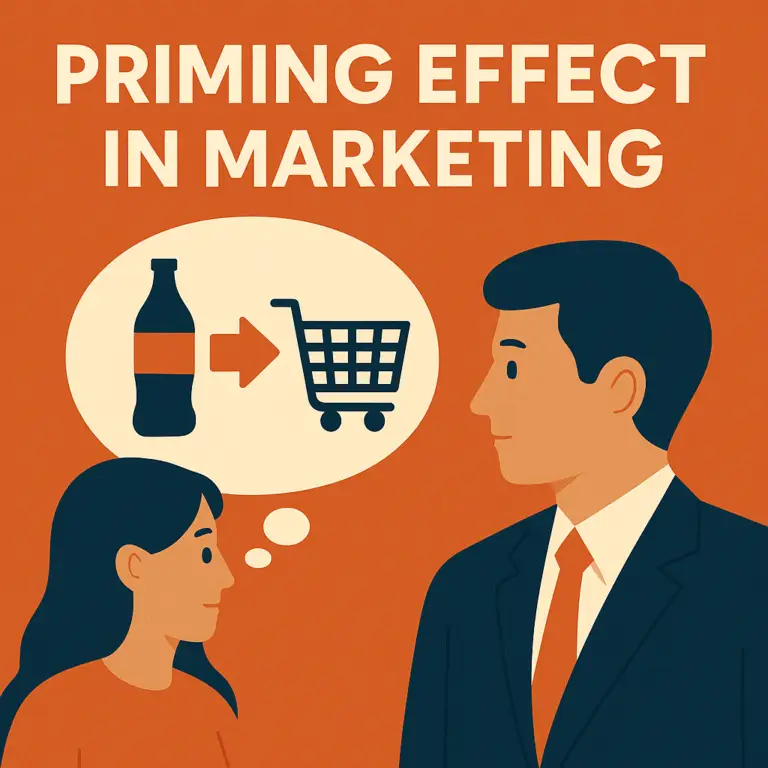
Ever wondered why certain adverts, sounds, or images can instantly influence your mood or decisions? That’s the power of priming effects! From the colour schemes used in fast food outlets to the background music in shops, marketers exploit priming to shape our thoughts, feelings, and purchasing habits.
For brands and marketers, understanding what priming is and applying it cleverly provides a significant advantage in creating more persuasive, customer-focused experiences, without being overtly obvious about it.
Key Takeaway:
- Priming shapes consumer decisions subconsciously. Strategic exposure to subtle cues, like colours, sounds, or words, can activate specific associations in the consumer’s mind, influencing choices without overt persuasion.
- Different types of priming target emotions, thoughts, and actions. From affective (emotion-based) to semantic (language-based) priming, marketers can design campaigns that align with how consumers feel, think, and behave.
- Real-world brands use priming to drive engagement and sales. Companies like Coca-Cola, McDonald’s, and Red Bull use visual, auditory, and contextual primes to reinforce brand identity and shape buying behaviour effectively.
- Goal-aligned priming builds long-term value. The most impactful priming strategies are those that resonate with consumer goals and values, enhancing decision confidence without manipulation.
What Is the Priming Effect?
The priming effect occurs when exposure to a stimulus, often referred to as the ‘prime,’ influences our response to a subsequent stimulus, often without our even realising it. This concept comes from cognitive psychology and works by activating mental schemas or associative memory pathways. For example, if you see the word “doctor’, you might find it easier to recognise the word “nurse” shortly afterwards, because of the semantic link between the two.
Difference Between Priming and Nudging
While both strategies aim to influence behaviour, priming works on a subconscious level, whereas nudging typically involves intentional design choices to steer decision-making. Priming is about mental activation, while nudging focuses on structural guidance.
Why Does Priming Effect Happen?
Priming occurs because our brains are constantly on the lookout for patterns and shortcuts to process information more efficiently. When we come across a stimulus, our mind activates related ideas and associations stored in memory. This pre-activation makes it easier and quicker to process subsequent information connected to the prime, even if we’re not consciously aware of it. This process helps save mental energy and speeds up our responses, but it also provides marketers with a subtle way to influence behaviour by setting the right context or cues.
Types of Priming in Marketing
Priming in marketing comes in many different forms, each aimed at influencing various aspects of how consumers perceive, feel, or behave. Here’s a look at the most common types and how they’re used in real-world settings.
Affective, Behavioural, and Cognitive Priming
This grouping shows how priming can influence three key psychological systems: how we feel (affective), how we act (behavioural), and how we think (cognitive). Marketers often combine these techniques to craft campaigns that strike an emotional chord, encourage action, and persuade on a mental level.
- Affective Priming: Influences emotional responses by exposing consumers to mood-setting cues that evoke specific feelings.
- Example: Playing upbeat music in a gym to foster motivation.
- Builds positive brand associations and atmosphere.
- Behavioural Priming: Activates specific physical actions by subtly suggesting or mimicking behaviour.
- Example: Slogans like “Get Moving” increase the likelihood of purchase in sportswear.
- Encourages spontaneous or habitual behaviours.
- Cognitive Priming: Affects thought processes or judgments by activating related concepts in memory.
- Example: Cleanliness-related words make customers more attentive to hygiene claims.
- Shapes perception and evaluation of product benefits.
Semantic, Associative, and Repetition Priming
This section looks at how memory and language connections shape consumer behaviour. It discusses how related meanings, repeated exposure, or contextual links can lead to quicker recognition, stronger recall, or automatic preferences.
- Semantic Priming: Leverages words with similar meanings or category associations.
- Example: Seeing the word “doctor” makes you more likely to recognise the word “nurse.”
- Enhances processing fluency and recognition.
- Associative Priming: Connects concepts that are not semantically related but frequently paired in experience.
- Example: A luxury car shown next to an elegant model primes status or attractiveness.
- Builds implicit brand values through association.
- Repetition Priming: Enhances familiarity and recognition ease by repeatedly exposing consumers to the same stimulus.
- Example: Hearing the same jingle across multiple ads.
- Strengthens brand recall and purchase readiness.
| Types of Priming in Marketing | |||
|---|---|---|---|
| Type Category | Specific Type | Description | Example Use Case |
| Affective/Behavioural/Cognitive | Affective Priming | Triggers emotional responses | Upbeat music in fitness centres |
| Behavioral Priming | Encourages specific behaviours | “Get Moving” slogans | |
| Cognitive Priming | Influences perception/thoughts | Clean-related words → hygiene product interest | |
| Semantic/Associative/Repetition | Semantic Priming | Based on meaning/category connection | “Doctor” primes “nurse” |
| Associative Priming | Based on frequent pairings in experience | Luxury car + attractive model | |
| Repetition Priming | Enhances memory via repeated exposure | Jingles in TV ads | |
| Goal/Procedural | Goal Priming | Activates aspirational motivation | Athletic images promoting fitness |
| Procedural Priming | Influences decision-making process | Framing deals with “limited-time offer” language | |
Goal and Procedural Priming
This kind of priming involves a higher level of psychological activation, where cues influence motivation or the mental processes behind decision-making. It’s particularly effective when tapping into consumer aspirations or the mindset people have when shopping.
- Goal Priming: Stimulates desired end-states or motivational targets.
- Example: Showing fit athletes to prime fitness-related buying intentions.
- Increases relevance and goal congruence.
- Procedural Priming: Activates specific mental procedures or decision-making strategies.
- Example: Priming people with discount language to shift focus toward cost-saving behaviour.
- Encourages more systematic or heuristic processing depending on the context.
- Semantic Priming: Uses related meanings (e.g., “yellow” primes “banana”).
- Associative Priming: Links unrelated concepts (e.g., a luxury car next to an attractive model).
- Repetition Priming: Enhances response speed through repeated exposure to a stimulus.
Real-World Examples of Priming in Marketing
Applications of priming show how brands use subtle cues to guide perception, emotion, and behaviour, often without the consumer realising it. Below are examples of how leading brands integrate different forms of priming.
Coca-Cola and Emotionally Charged Imagery
Coca-Cola’s advertising often features images of smiling faces, vibrant colours, and the iconic red cans to evoke feelings of happiness, friendship, and celebration. The “Open Happiness” slogan, along with visuals of friends clinking Coke cans, acts as an emotional cue that brings to mind joy and refreshment.
- These cues work because they tap into universally shared emotional memories.
- By consistently pairing Coke with social and happy moments, consumers begin to link the drink with those positive states.
McDonald’s and Brand Associations
McDonald’s employs a mix of associative and repetition priming. The use of red and yellow colours is designed to stimulate the appetite and attract attention, while repeatedly seeing the golden arches and hearing the “I’m Lovin’ It” jingle helps reinforce a sense of familiarity and comfort.
- Over time, these repeated cues become linked to hunger and convenience.
- The priming effect builds automaticity: consumers may crave McDonald’s upon seeing the logo, even if they’re not hungry.
Nike and Goal-Oriented Motivation
Nike’s legendary “Just Do It” campaigns subtly inspire viewers by showcasing athletic greatness, personal milestones, and dedication. The adverts often feature top athletes in action, highlighting the spirit of perseverance.
- This primes aspirational goals in consumers, motivating them to become fitter, stronger, or more determined.
- The psychological effect aligns Nike products with self-improvement and motivation, boosting brand relevance among active consumers.
Retail Spaces and Sensory Cues
Retail environments often employ sensory priming to influence shopper behaviour. For example, playing classical music in fine dining settings can enhance the perceived quality, while the smell of freshly baked bread in supermarkets tends to encourage customers to stay longer and make impulse buys.
- These ambient cues work subconsciously to influence perception of quality, comfort, and even price tolerance.
- When primed by pleasant sensory inputs, consumers become more receptive and relaxed, ideal conditions for purchasing.
Social Media Influencer Campaigns
Influencers frequently use framing and verbal priming in their content. For example, a post that begins with “This changed my routine!” can set a positive tone and encourage viewers to see the content in a favourable light. Coupled with the influencer’s genuine tone, this approach helps build trust with the audience.
- By front-loading positive language, the viewer’s mindset is shifted before the product is introduced.
- This makes branded messages more persuasive and less likely to trigger scepticism.
How to Use Priming in Marketing
To make priming work well, marketers need to match cues with what consumers think and feel, as well as their campaign goals and ethical considerations. Here are some practical tips on how to include different kinds of priming in your marketing strategies.
Prime Emotion Through Design and Atmosphere
Emotions play a crucial role in shaping consumer behaviour. Affective priming uses visual, auditory, and environmental cues to evoke feelings that subtly influence our decisions, often without us even realising. Brands that successfully employ emotional design tend to foster stronger loyalty, trust, and better recall among consumers.
- Use warm colours, uplifting music, or joyful imagery to create an emotional environment.
- Design product packaging or landing pages to visually evoke emotions such as trust, calmness, or excitement.
- Affective priming works best when the emotion aligns with the product or context, e.g., serenity in wellness brands or energy in fitness brands.
Reinforce Familiarity Through Repetition
Consumers tend to favour stimuli they’ve come across before, even if they can’t quite remember them. Repetition priming works by strengthening mental accessibility, making your brand feel more familiar, trustworthy, and easier to recall, particularly in busy markets.
- Consistently use brand slogans, jingles, icons, and visual motifs across touchpoints.
- Repeated exposure increases processing fluency, making your message easier to comprehend.
- This tactic is particularly effective in low-involvement categories where habit and recognition drive choice.
Associate Your Brand with Meaningful Contexts
Associative and semantic priming help create subconscious links between your brand and emotionally resonant themes, values, or experiences. By placing your product in relevant contexts, you activate mental shortcuts that tend to view the brand more positively.
- Collaborate with influencers or causes that align with your brand purpose to establish value-based associations.
- Use key phrases or imagery that connect with desired consumer identities, like freedom, health, or innovation.
- These associations activate related schemas in memory, shaping how consumers interpret your brand.
Trigger Goal-Oriented Behaviour
Consumers are often driven by aspirations, whether it’s aiming for better fitness, success, or happiness, and goal priming taps into these ambitions. When marketing campaigns visually or verbally reinforce a particular goal, they tend to make products seem more appealing and motivating.
- Use testimonials and success stories that show goal achievement using your product.
- Highlight how your offering helps customers move toward future-oriented outcomes.
- Goal priming is particularly impactful in categories like health, education, and personal finance.
Prime Cognitive Focus During Decision-Making
Different stages of the purchasing journey call for different mental approaches. Using procedural and cognitive priming can influence how consumers make decisions, whether through logical comparisons or gut feelings.
- Prime analytical thinking with comparisons, data-driven visuals, or framing like “smart choice” or “best value.”
- To encourage faster, emotional decisions, highlight urgency, simplicity, or pleasure-driven language.
- Tailor the priming approach to your funnel stage, cognitive for consideration, and affective for conversion.
Conclusion
Priming effects might seem subtle, but they can have a significant impact on consumer behaviour. Marketers craft perceptions, emotions, and decisions through subtle cues to build stronger brand connections and boost engagement. The trick is to understand the psychological mechanisms at play and align messaging with what consumers value, their goals, and the context in which they are. As marketing becomes increasingly personalised and behaviourally focused, priming remains a powerful tool that blends psychology with persuasion.
FAQ
The priming effect in marketing refers to the psychological phenomenon where exposure to certain stimuli (like words, images, or sounds) influences consumer thoughts, feelings, or behaviours later on, often without conscious awareness. For example, upbeat music in a store can prime customers to feel more positive, thereby increasing their likelihood of making a purchase.
Priming can be grouped into several types based on what it influences:
– Affective Priming: Shapes emotions (e.g., mood-setting visuals).
– Behavioural Priming: Triggers physical actions (e.g., action verbs in slogans).
– Cognitive Priming: Alters thought processes (e.g., word choice affecting perception).
– Semantic Priming: Uses word meaning relationships.
– Associative Priming: Builds links through repeated pairing.
– Repetition Priming: Enhances familiarity through repeated exposure.
– Goal Priming: Activates personal aspirations (e.g., fitness, success).
– Procedural Priming: Influences how people make decisions.
Each type serves a strategic function in marketing, from boosting recall to driving conversions.
To use priming effectively in marketing:
– Prime Emotions through colour, music, and imagery to set the mood.
– Build Familiarity via repetition in logos, slogans, or ad formats.
– Use Associations to connect your brand with desired values or lifestyles.
– Trigger Goals by showing aspirational imagery that aligns with consumer ambitions.
– Guide Decision-Making by framing options with cues that direct attention or mindset.
The key is alignment; priming strategies should match your audience’s context, desires, and stage in the buying journey.
